Commercial Flat Roof Repair Cost in New York 2026
Commercial flat roof repair in New York typically runs about $3 to $10 per square foot for localized membrane, seam and flashing work, and small leak repairs commonly land in the low thousands of dollars. Full replacement is a different budget: roughly $8 to $20 per square foot in NYC, depending on the roofing system, insulation, deck condition and site access.
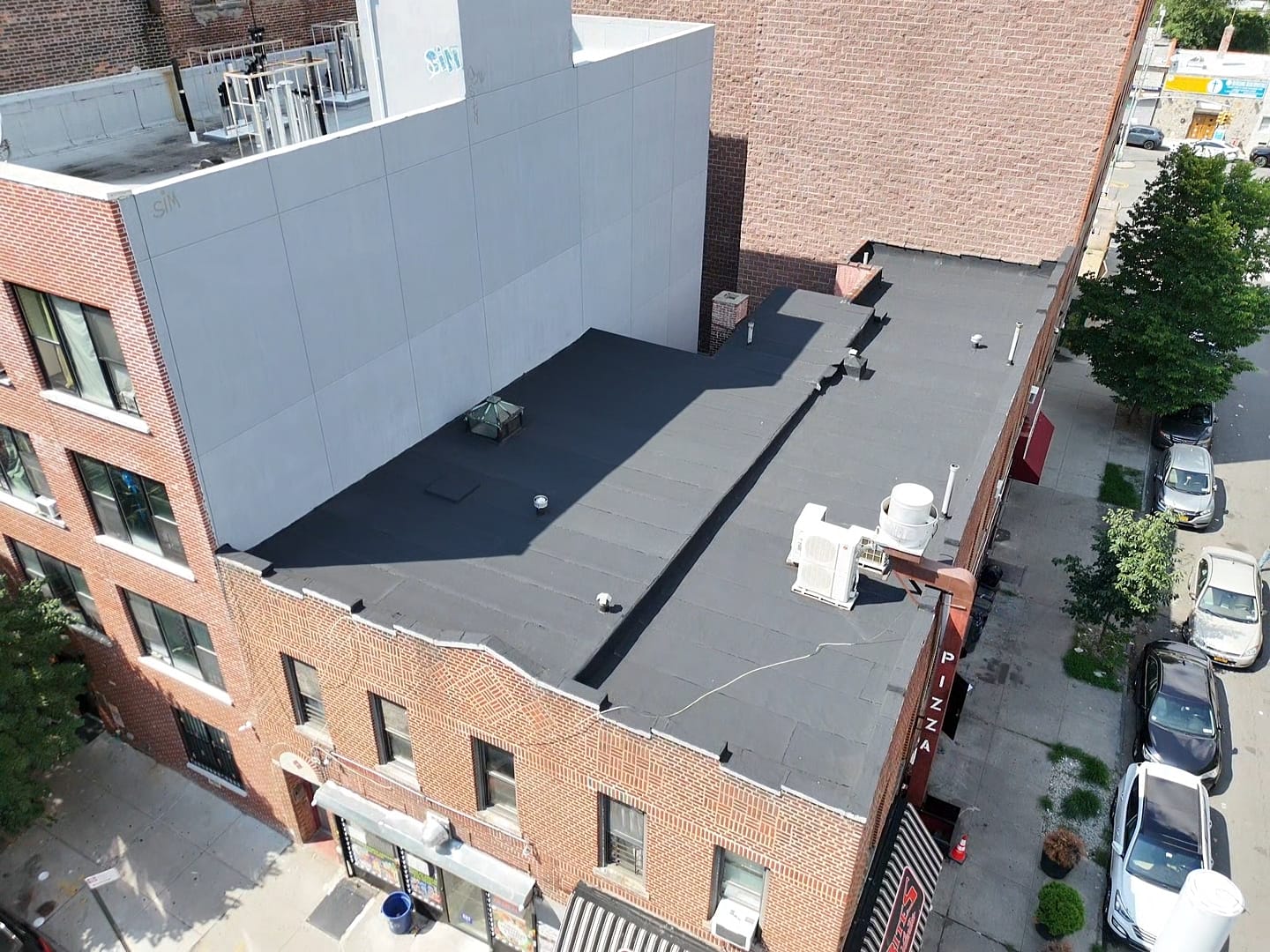
Those are planning ranges, not quotes. The number that matters is set by one question: where is the water getting in, and how far has it traveled? A cracked seam on a dry roof is a modest repair. The same leak on a roof with saturated insulation is a different job.
This guide breaks down what moves the price, what repairs cost by problem type and roofing system, when repair stops making financial sense, and how to compare contractor quotes in New York City.
Commercial flat roof repair cost at a glance
| Scope of work | Planning range | What to know |
| Localized patch, seam or flashing repair | ~$3–$10 per sq ft of repaired area | Small jobs are usually a lump sum with a service minimum rather than a true per-foot price. |
| Larger section repair (wet insulation, deck work) | Approaches replacement pricing for that area | Once insulation or deck must be replaced, you are paying for a mini re-roof. |
| Coating or restoration system | Fraction of replacement cost | Only suits a sound membrane over dry insulation. Ask for per-sq-ft pricing and warranty terms. |
| Full replacement (NYC commercial) | ~$8–$20 per sq ft | Published guides disagree widely. Insulation, tapered drainage and access drive the spread. |
Published cost guides conflict with each other. National aggregators put flat roof replacement near $4–$14 per square foot, Angi’s New York City guide lists $6–$14, and NYC contractors publishing commercial-specific ranges often quote $8–$20. The gap is mostly scope. Cheaper figures tend to assume a simple recover over sound insulation; higher ones include tear-off, tapered insulation, new flashings and NYC logistics.
EXPERT INPUT OPPORTUNITY: Replace the planning ranges above with RH Renovation’s actual 2026 job ranges: typical minimum service charge, a recent small leak repair price, and a recent section repair price (with square footage and system type).
A worked example
Suppose a 5,000-square-foot TPO roof has a failed seam and a leaking pipe boot, affecting about 400 square feet. At $3–$10 per square foot, the localized repair is roughly $1,200–$4,000. Replacing that whole roof at $8–$20 per square foot would be $40,000–$100,000. This is illustrative arithmetic, not a quote, but it shows why an early, accurate repair is the cheapest roof decision a building owner can make.
What drives commercial roof repair pricing
Contractors price a repair from five or six variables. Knowing them lets you read an estimate critically.
1. How far the water has spread
A membrane breach is cheap to fix. Wet insulation is not. Water travels laterally between the membrane and the deck, so the leak you see inside may be 20 feet from the actual entry point. If insulation is saturated, it has to be cut out and replaced, because wet insulation loses R-value and keeps feeding moisture back into the assembly.
2. Roofing system and condition
Single-ply membranes (EPDM, TPO, PVC) are repaired by cleaning, patching or heat-welding. Modified bitumen and built-up roofing are repaired with torch, hot-mop or cold-applied methods. Repair price depends on whether the existing material will still accept a patch. Aged membranes can be too brittle or contaminated to weld, which pushes work beyond a simple patch.
3. Penetrations, flashing and terminations
Most commercial flat roof leaks start at details, not in the open field: pipe boots, HVAC curbs, skylights, parapet walls, roof drains, expansion joints and edge metal. Flashing repair is detail work that takes more labor per square foot than a field patch, which is why a small repair can cost more per square foot than expected.
4. Drainage
Clogged drains and scuppers, poor slope and sagging deck sections all cause ponding. NRCA’s criterion for proper drainage is no ponding water 48 hours after rain under conditions that allow drying. Ponding that outlasts that window is a repair driver, and it can also affect manufacturer warranty coverage. Fixing the cause (clearing drains, adding a drain, installing tapered insulation) costs more than patching the symptom but prevents repeat leaks. Related gutter and downspout work is covered on our gutter repair and installation.
5. Access and logistics in New York City
This is where NYC pricing diverges from national averages. Roof access via a single narrow stair or ladder, limited material staging, scaffolding or hoisting on multi-story buildings, sidewalk protection, and working around occupied tenant space all add labor hours. Professional judgement: logistics frequently explain more of the price gap between a quote in New York and a national average than material cost does.
6. Urgency
Emergency and storm repairs are priced for speed, with temporary tarping or dry-in first and permanent repair later. Scheduling a repair before the wet season is generally cheaper than a same-night call.
Repair cost by problem type
| Problem | Typical fix | Cost behavior |
| Seam failure or open lap | Clean and re-weld (TPO/PVC) or re-adhere/tape (EPDM) | Low if surrounding membrane is sound; rises if seams fail across a large area |
| Punctures and tears | Patch with compatible membrane | Low per patch; cost grows with number of patches and foot-traffic damage |
| Failed flashing or pipe boots | Replace flashing, boots, termination bars, sealant | Higher labor per sq ft; common source of repeat leaks if only caulked |
| Blisters and bubbles | Cut open, dry, patch (bitumen systems) | Moderate; moisture inside the blister can signal wet insulation |
| Ponding water | Clear drains, add drains or tapered insulation | Higher if slope correction needed; low if it is just clogged drains |
| Wet insulation or deck damage | Cut out and replace affected sections | Highest repair tier; compare to replacement |
| Storm damage | Temporary dry-in, then permanent repair | Varies with scope; document damage for your insurer |
Repair cost by roofing system: EPDM, TPO, PVC, modified bitumen and built-up
The system on your roof affects both repair method and long-term strategy. Lifespans below are general industry ranges and vary with installation quality, exposure and maintenance.
| System | Typical life | Repair notes |
| EPDM (rubber) | 20–30 yrs | Patches and seam tape work well on clean, sound rubber. Old EPDM can be hard to bond; flashing details are the usual weak point. |
| TPO | 15–25 yrs | Heat-welded seams are repairable by welding fresh patches. Aged or dirty TPO can resist welding, adding prep. |
| PVC | 20–30 yrs | Welded like TPO; strong chemical resistance for restaurants and rooftop exhaust. Membrane cost is typically higher. |
| Modified bitumen | 15–25 yrs | Common on NYC low-slope buildings. Repairs use torch or cold-applied methods; surface granule loss and blistering are typical late-life signs. |
| Built-up roofing (BUR) | 20–30 yrs | Layered asphalt and felts. Repairable, but many older roofs have layered repairs and moisture trapped between plies. |
Comparing systems for a future replacement? Single-ply systems generally install faster, while multi-layer bitumen systems are valued for redundancy. Ask your contractor which fits your roof’s traffic, rooftop equipment and drainage.
Repair or replace a commercial flat roof?
Repair when damage is localized, the membrane is in reasonable condition and the insulation is dry. Replace when problems are widespread, repeat repairs are stacking up, or moisture has spread through the insulation.
A commonly used rule of thumb is to start seriously pricing replacement when repair estimates approach a third to half of replacement cost, or when a significant share of the roof area has wet insulation. That is professional judgement, not a code requirement, but it keeps owners from paying for a string of patches on a failing roof.
Signs a commercial flat roof needs replacement
- Leaks that return after professional repairs, especially in different locations
- Moisture survey results showing saturated insulation across a large area
- Widespread membrane cracking, shrinkage, blistering or seam separation
- Chronic ponding caused by deck sag or inadequate slope
- A roof near or beyond its expected service life with rising repair frequency
The NYC rule that changes the math
In New York City, replacing the entire roof deck or roof assembly can trigger Local Laws 92 and 94, which require a sustainable roofing zone (a solar photovoltaic system, a green roof, or a combination) covering the roof. The Department of Buildings states this applies to alterations where the entire existing roof deck or roof assembly is being replaced. A localized repair is not that condition. Whether your project triggers the requirement depends on scope and exemptions, so confirm with your contractor or the NYC Department of Buildings before budgeting a full replacement. This is one reason a well-timed repair or restoration can be financially different in NYC from the same decision elsewhere.
Replacement also brings other cost layers: tear-off and disposal, insulation upgrades to meet current energy code, and drainage corrections. Our commercial flat roof system replacement case study shows what a full re-roof scope looks like on a real project.
Commercial flat roof maintenance cost vs. emergency repair
Preventive maintenance is typically a small fraction of a roof’s lifetime cost, and it is where most avoidable repair bills disappear. A practical maintenance program includes two inspections a year (spring and fall), plus a check after major storms. Each visit should cover:
- Clearing roof drains, scuppers and gutters of debris
- Inspecting seams, flashing, sealants and penetrations
- Looking for ponding, blistering, punctures and foot-traffic wear near equipment
- Documenting condition with dated photos, which also supports warranty and insurance claims
Rooftop HVAC technicians and other trades are a common source of punctures. Restricting access and adding walkway pads at service routes costs little compared with the repairs they prevent.
How to get an accurate commercial roof repair estimate
A phone quote for a leak repair is a guess. A useful estimate follows an inspection, and it should be written to be compared line for line.
- Inspection of the full roof, not just the leak location. The contractor should check seams, flashing, drains, penetrations and surface condition, and note ponding.
- Moisture assessment where leaks are suspected. Non-destructive moisture surveys (infrared, nuclear or capacitance) and core samples help establish whether insulation is wet. They are often a separate paid service, and worth it on larger roofs.
- Written scope with quantities. Square footage of repair, linear feet of flashing, number of penetrations, and who handles disposal.
- Materials and method named. Membrane type compatible with your existing roof, and fastening or adhesive method.
- Warranty and workmanship terms. Know what the contractor warrants and what a membrane manufacturer’s warranty does and does not cover.
- Proof of license and insurance, and permit responsibility. Ask who files and pays for any required permits.
Common mistakes that cost owners money
- Caulking over the symptom. Sealant on a failing detail buys a few months and hides the real condition.
- Choosing on lowest price alone. Compare scope. A cheap quote that skips wet-insulation removal is not cheaper.
- Ignoring drainage. Patching a ponding area without fixing why it ponds invites a repeat leak.
- Waiting for interior damage. By the time a ceiling stains, insulation and deck are often already affected.
- Overlaying incompatible materials. Some patches and coatings do not bond to some membranes; compatibility matters.
Does cost differ by borough?
Yes, mostly through logistics rather than materials. As general professional observations: Manhattan buildings often add hoisting, street and sidewalk protection and tight access; Brooklyn and Queens have many mixed-use and attached buildings with shared parapets and limited staging; the Bronx and Westchester include multi-family, light-industrial and retail roofs where size and rooftop equipment drive scope; Staten Island and Long Island commercial roofs are often larger with easier access but more exposure to wind and storm damage. These are tendencies, not rate cards.
RH Renovation serves the Bronx, Brooklyn, Queens and Westchester County. For properties in other areas, call to confirm availability.
Professional commercial flat roof repair in New York
RH Renovation LLC (RH Renovation NYC) is a licensed, insured roofing contractor based at 1951 Hone Ave in the Bronx, led by owner Rexhap Halilaj, with Tony as the main point of contact. The company is a GAF Master Elite® certified contractor (GAF’s residential roofing program), holds a 5.0-star rating across customer review platforms and an A+ rating from the Better Business Bureau.
For commercial and multi-family flat roofs, the team starts with an inspection and a written estimate that separates the repair from any larger recommendation, so you can see what a repair fixes and when replacement becomes the better investment. Explore our flat roof repair and replacement services, or see the broader roof inspection, repair and installation page. Where leaks start at a chimney or a roof edge, our chimney repair and gutter teams address the connected details so the fix isn’t undone by the next storm.
Get a clear repair estimate: call (646) 818-4305 or request a free estimate. Have your roof’s approximate size, the system type if known, and photos of the leak area ready.
Frequently asked questions
How much does commercial flat roof repair cost?
Localized repairs commonly run about $3–$10 per square foot, and small leak repairs often total a few thousand dollars. Costs rise sharply if insulation or deck must be replaced. A written estimate after a full inspection is the only reliable number.
How much does commercial roof repair cost in New York?
Expect NYC pricing to sit above national averages because of access, labor, hoisting and logistics. Per-square-foot repair ranges are similar to national figures, but minimum service charges and access costs make small jobs relatively pricier.
What is the commercial flat roof cost per square foot for replacement?
National guides cite roughly $4–$14 per square foot, Angi lists $6–$14 for New York City flat roofs, and NYC commercial contractors often quote $8–$20 depending on system, insulation and access. The exact figure depends on an inspection.
Is it cheaper to repair or replace a commercial flat roof?
Repair is cheaper in the short term when damage is localized and insulation is dry. If repairs are frequent or moisture is widespread, replacement usually costs less over time than repeated patching.
How long does a commercial flat roof last?
Most single-ply and bitumen systems last roughly 15–30 years depending on type, installation quality and maintenance. Drainage problems and neglected maintenance shorten that.
What causes commercial flat roof leaks?
The most common sources are failed flashing and penetrations, open seams, punctures, clogged drains and ponding water. Leaks often appear far from where water actually enters the roof.
Do I need a permit for commercial roof repair in NYC?
Requirements depend on scope. A full roof deck or assembly replacement can trigger Local Laws 92 and 94 (sustainable roofing zone), while a localized repair does not. Confirm with the NYC Department of Buildings or your contractor, and ask who is responsible for filing.
How often should a commercial flat roof be inspected?
Twice a year (spring and fall) plus after major storms is a sound baseline, with drains cleared each time.